Stripe's stablecoin blockchain Tempo launches public testnet

cointelegraphPublished on 2025-12-10Last updated on 2025-12-10

Abstract

Stripe and Paradigm's blockchain project Tempo has launched its public testnet, a key milestone toward its official layer-1 blockchain release. The open-source testnet allows users to run nodes and test features like dedicated payment lanes, stablecoin-native gas, a built-in decentralized exchange, and fast deterministic finality. Tempo is designed for instant settlement, low fees, and a stablecoin-native experience tailored for financial applications. Users can create stablecoins directly from their browser using Tempo’s TIP-20 token standard. The project, which raised $500 million at a $5 billion valuation three months ago, has added major design partners including Mastercard, UBS, and Klarna, which recently launched a USD-pegged stablecoin on the network.

Stripe and Paradigm’s joint blockchain project Tempo has launched its first public testnet, marking a major step forward to launching the official layer-1 blockchain.

According to a Tuesday announcement from Tempo, the open source testnet is now live with anyone being able to “run a node or sync the chain” and test out a range of features.

“Today's testnet launch kicks off the next phase of Tempo's development, with a focus on scale, reliability, and integration experience. Over the coming months, we'll continue onboarding new infrastructure partners, adding new features and developer tooling, and stress-testing throughput under real payment loads,” Tempo said.
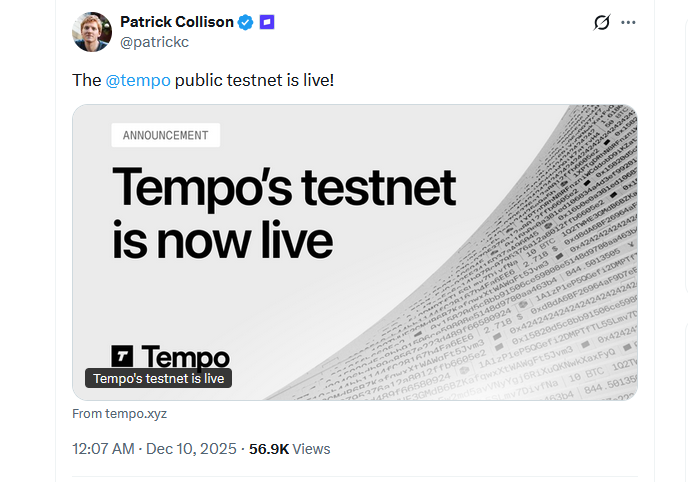
Source: Patrick Collison

The announcement highlighted six key features live on the network. These include: dedicated payment lanes, stablecoin-native gas, built-in stable asset decentralized exchange, payments and transfers metadata, fast deterministic finality and modern wallet signing methods.

“Tempo is built to deliver instant, deterministic settlement, predictably low fees, and a stablecoin-native experience, which are qualities that most general-purpose blockchains still struggle to provide for financial applications,” Tempo said.

Related: Blockchain trial on Canton Network tests collateral reuse with tokenized US Treasurys

In an X post following the launch, Paradigm general partner and chief technology officer Georgios Konstantopoulos highlighted a feature that enables Tempo testnet users to create stablecoins directly from their browsers.

Stablecoins created on the network will be built via Tempo’s TIP-20 token standard. However, the specific liquidity and collateral requirements for when the actual blockchain launches are not explicitly listed in the testnet docs.
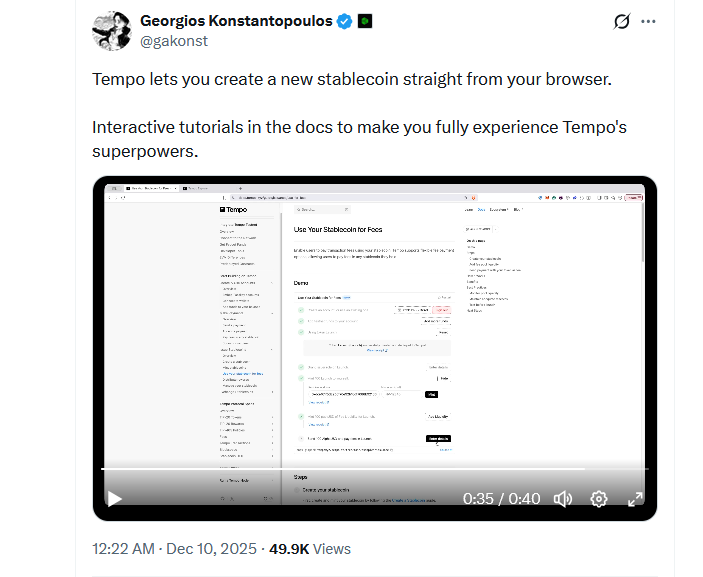
Source: Georgios Konstantopoulos

Tempo shows strong momentum as design partners grow

The testnet arrives four months after Stripe and Paradigm initially unveiled Tempo, and three months after it raised $500 million at a $5 billion valuation. The project kicked things off with heavy hitter design partners such as OpenAI, Deutsche Bank, Standard Chartered and Shopify.

In the latest announcement, Tempo emphasized that it has since signed on a host of new design partners, including big names such as Mastercard, UBS, Kalshi and Klarna.

Late last month, Klarna, the EU-licensed buy-now-pay-later firm, rolled out a USD-pegged stablecoin on Tempo, becoming the first digital bank on the network to do so.

Magazine: 13 Christmas gifts that Bitcoin and crypto degens will love
Related Reads

Central Bank Responds to Call to 'Exit the Sandbox' and Allows Stablecoins

Sberbank CEO Herman Gref expressed the bank's hope for the authorization of stablecoins for domestic transactions in Russia, stating that Sber is actively discussing this possibility with the Bank of Russia. He emphasized the need to move beyond the current regulatory "sandbox" and allow basic transactional functionality with stablecoins, primarily ruble-denominated tokens for internal use. However, the Bank of Russia maintains its position that stablecoins are a form of cryptocurrency and excludes their use for domestic payments. Kirill Pronin, head of the central bank's financial market infrastructure department, argued that Russia's digital payment ecosystem is already highly developed, making such authorization unnecessary. The article notes that Russia currently operates with Digital Financial Assets (DFAs), which are tokenized versions of real assets issued on approved blockchain platforms. Some foreign digital rights, including compliant stablecoins, can be classified as DFAs. The first such recognized asset was a Kyrgyzstani ruble stablecoin, permitted only for foreign economic activity. Pronin also mentioned that the central bank is considering allowing banks and token issuers to directly issue digital assets in public blockchains, as the current method of transferring domestically issued tokens to open networks has not gained significant traction. This shift could reduce operational costs and cybersecurity risks.

RBK-cryptoHace 8 min(s)

Central Bank Responds to Call to 'Exit the Sandbox' and Allows Stablecoins

RBK-cryptoHace 8 min(s)

17 Most Anticipated Things in the Cryptocurrency Space in 2026

17 Key Crypto Developments to Watch in 2026 Stablecoin on/off ramps will mature, connecting digital dollars to local payment systems and enabling new behaviors like real-time cross-border payments and merchant adoption without bank accounts. Stablecoins will evolve into a foundational internet settlement layer. RWA tokenization will shift toward crypto-native approaches like perpetual futures for deeper liquidity. Stablecoins will see more native issuance rather than tokenization, and on-chain native debt issuance will reduce costs and improve accessibility. Banks will leverage stablecoins to innovate without overhauling legacy systems. The internet itself will become a banking layer as value moves programmatically via smart contracts and new primitives like x402. Wealth management will become personalized and automated for everyone via tokenized assets and AI-driven portfolio management. DeFi tools and tokenized private markets will expand access. AI agents will require identity verification (KYA - Know Your Agent) and new economic models to compensate content creators as agents scrape the open web. AI will also enable new research methodologies via layered, reasoning agents. Privacy will become crypto's key moat, creating strong network effects as bridging between private and public chains risks metadata leakage. Decentralized, quantum-resistant messaging will rise, emphasizing user ownership. "Secrets-as-a-service" will emerge for programmable data access control. DeFi security will evolve from "code is law" to "specification is law" with runtime enforcement of invariants. Prediction markets will expand with more contracts, AI-powered oracles, and decentralized governance. "Staked media" will rise, where commentators back arguments with verifiable, on-chain commitments. SNARKs will become efficient enough (~10,000x overhead) for verifiable cloud computing, moving beyond blockchain. Finally, crypto market structure regulation could align legal and technical frameworks, enabling networks to operate as truly open, decentralized systems.

marsbitHace 9 min(s)

17 Most Anticipated Things in the Cryptocurrency Space in 2026

marsbitHace 9 min(s)

Trading

Spot
Futures
活动图片